
Research Significance and Objectives
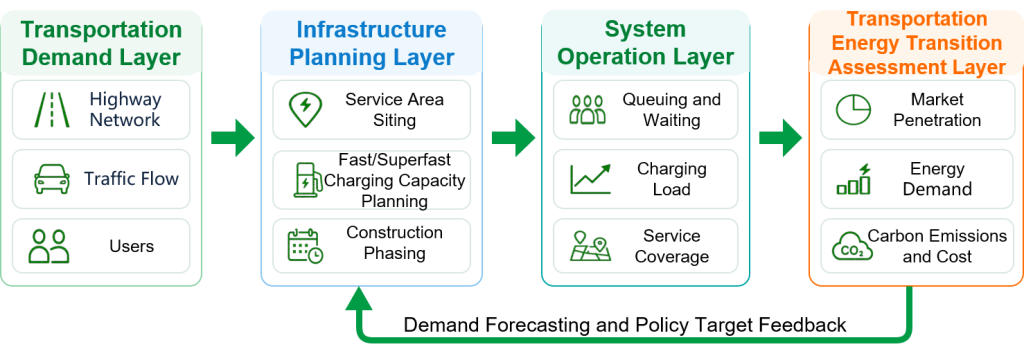
To address the needs of transportation energy transition, this research develops an integrated planning and deployment framework covering demand, infrastructure, operation, and transition. It supports infrastructure development, market evolution assessment, and low-carbon transition decision-making, establishes a two-way feedback mechanism between infrastructure planning and transportation energy transition assessment, and forms phased and sustainable deployment plans for transportation energy systems.
Research Content
1. Highway charging network planning: Conduct road network and service area modeling, traffic demand and OD identification, site selection and capacity planning, queuing simulation, construction phasing, and investment prioritization.
2. Transportation energy market transition: Forecast technology pathways and market penetration, estimate energy demand and load, analyze carbon emissions and reduction pathways, and evaluate cost-effectiveness and policy scenarios.
3. Integrated simulation and platform deployment: Support scenario setting and dynamic assessment, package models into web-based tools, provide online decision support and planning outputs, and enable rolling updates and comparative analysis.
Application Scenarios
1. Government planning and policymaking: Support scientific layout, optimize resource allocation, and facilitate policy implementation.
2. Investment decisions for operators: Quantify benefits and risks, and optimize investment portfolios and returns.
3. Construction and operation of highway service areas: Plan facilities rationally and improve service capacity and operational efficiency.
4. Low-carbon strategies for energy enterprises: Forecast demand and emission reduction pathways to support low-carbon transition.
5. Policy assessment for the transportation sector: Evaluate policy impacts and optimize implementation pathways.
Research Achievements
He X*, Ou S*,et al. Greenhouse gas consequences of the China dual credit policy. Nature Communications. 2020. JCR Q1, IF 15.7
Han L, Ou S*, et al. Quantitative modeling of China’s commercial vehicle powertrain transition toward 2050: Market penetration, uncertainty, and policy impacts. Energy. 2026. JCR Q1, IF 9.4