

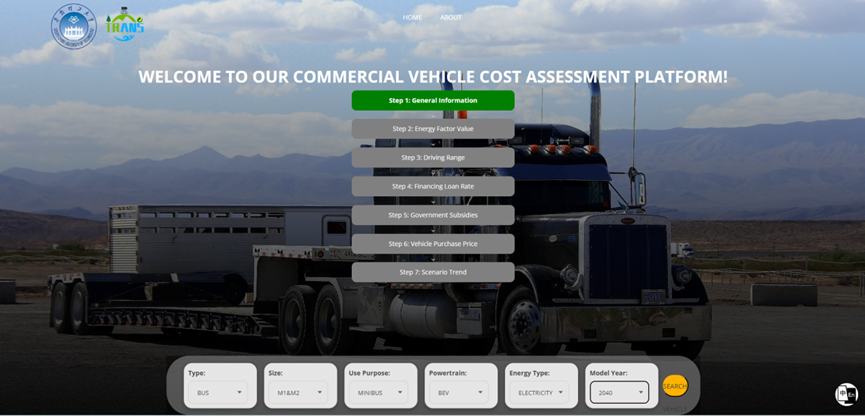
As China rapidly advances in alternative energy and transportation energy-saving technologies, the Total Cost of Ownership (TCO) for commercial vehicles, particularly including hidden costs like charging inconvenience and range anxiety, has become an important subject requiring in-depth research. This is not only a key element in assessing the economic benefits throughout a vehicle’s lifecycle but also provides significant guidance for promoting the transformation of transport energy and achieving carbon emission reduction goals.
The released TCO Model integrates multidimensional data, including government reports, industry databases, and economic research. It categorizes data into basic data, trigger data, and scenario-based data, constructing a multi-source cloud database. The model is designed with a multi-scenario modeling framework that automatically updates based on specific parameters. It systematically evaluates the changes in the TCO and key elements of China’s commercial vehicle power systems under different scenarios from 2020 to 2040. The model covers nearly 200 types of commercial vehicles, encompassing various vehicle models (such as minibuses, midsize buses, and light trucks) and power systems (including internal combustion engines, electric, and fuel cells) in different usage scenarios. It aims to provide comprehensive and scientific cost analysis and forecasting support for the transportation and energy industries.
In December 2024, the TCO Model will be officially launched! It supports switching between Chinese and English interfaces.
Website link: http://tco.translab.top/
Click to read more and jump to the website.
✨ Interpretation of Current Functions of TCO Model
- Systematic analysis of TCO components
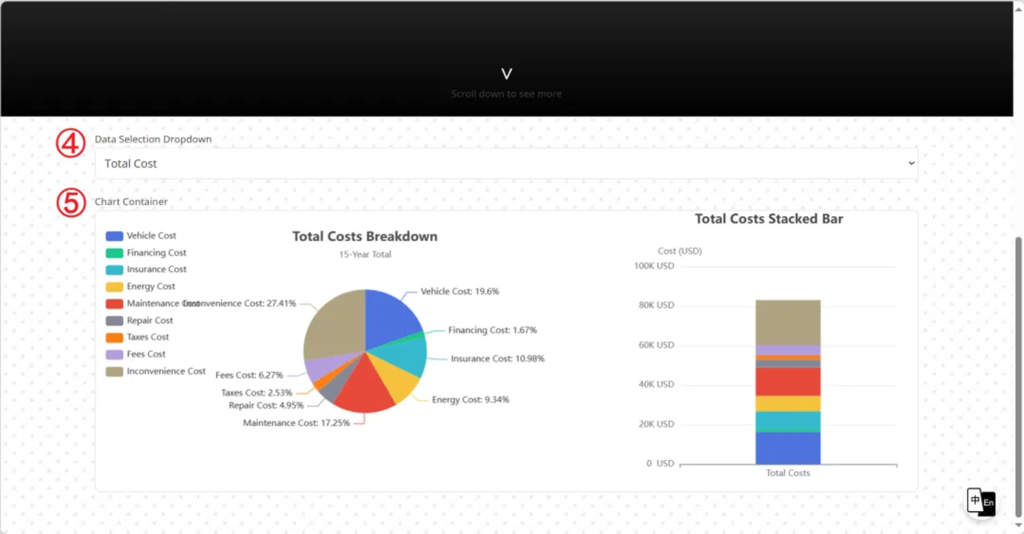
The TCO Model divides the TCO of commercial vehicles into eight major categories: vehicle costs, financing costs, insurance costs, energy costs, maintenance costs, repair costs, taxes, and hidden costs. Hidden costs refer to cost factors that are difficult to perceive during usage, such as range anxiety, charging/refueling inconvenience. - Predicting the evolution of TCO for different types of commercial vehicles in the future
The TCO Model not only focuses on the changing trends of TCO for various types of commercial vehicles over the next twenty years but also delves into analyzing key influencing factors such as policy environment, technological advancements, and fuel price fluctuations. By systematically analyzing the eight cost categories, the TCO Model comprehensively forecasts the evolving trends of costs from 2020 to 2040 and evaluates the impact of these changes on TCO. - Sensitivity analysis of TCO under various scenarios
The TCO Model constructs three major scenario models: optimistic, standard, and pessimistic scenarios, each based on different economic and technological conditions, to predict and evaluate the development path of commercial vehicle TCO over the next 20 years.
✨ Overview of Key Functional Areas on the TCO Model Website
On the official TCO Model website, users can input relevant data following the guide to obtain the proportion and numerical values of the various TCO cost components for a target vehicle in specific years. They can also view bar graphs and pie charts illustrating the predicted TCO changes up to 2040. Through various scenario assumptions analysis, users can fully understand the evolving patterns of TCO for commercial vehicles. By comparing the performance of the same vehicle model under different power systems and in different years, users can intuitively perceive the differences and development trends of TCO.
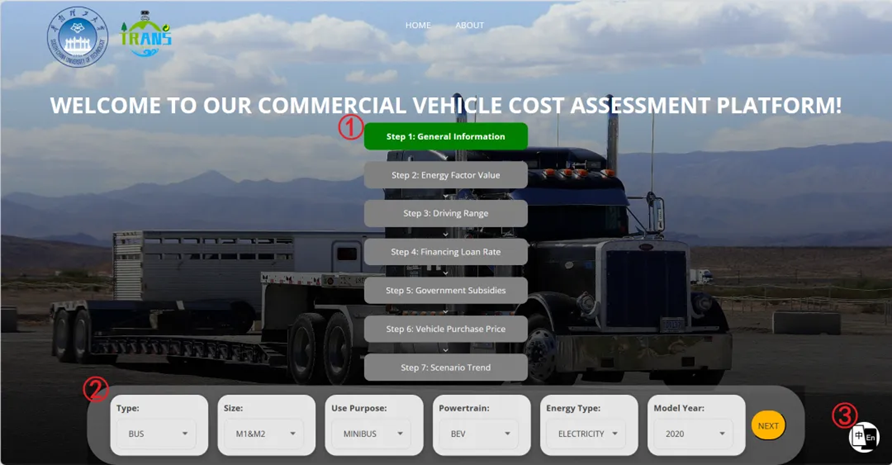
- TCO Model Website Homepage
① Step Navigation Bar: Guides users to sequentially complete seven steps to input the necessary information for calculating TCO. Users can flexibly switch to other steps at any point.
Step 1 General Vehicle Information: Input vehicle type (such as truck or bus), size, and energy type.
Step 2 Energy Rate Factor: Provide energy rate factor.
Step 3 Driving Range and Maintenance: Input expected driving range and maintenance scenarios (divided into high, standard, and low maintenance scenarios).
Step 4 Financing and Loan Rate: If the vehicle is purchased through financing, input loan rate and term (or use default settings).
Step 5 Government Subsidies and Fast Charging Options: Input local government subsidies for electric vehicles and select whether the vehicle supports fast charging function (or use default settings).
Step 6 Vehicle Purchase Price: Provide vehicle purchase price information (or use default settings).
Step 7 Scenario Selection: Choose between optimistic, reference, and pessimistic scenarios, each including different assumptions regarding technological advancements, energy costs, and maintenance trends.
②Attribute Setting Bar: Allows users to make detailed settings at each step. After completing the attribute settings for the current step, click the “Next” button to proceed to the next step for further configuration. Users can finely adjust the corresponding parameters at each step.
③ Language Switch Button: Easily switch between Chinese and English, automatically synchronizing currency measurement units (CNY/USD) to match real-time exchange rates. - TCO Model Website Results Page
Once users complete all seven steps of configuration, the system will redirect to the results page. At this point, users can select the desired visualization chart type in the chart type selection box. Once selected, the visualization results area below will visually display the TCO data and trends of the chosen chart type, aiding users in gaining a comprehensive insight into the overall performance of commercial vehicle TCO.
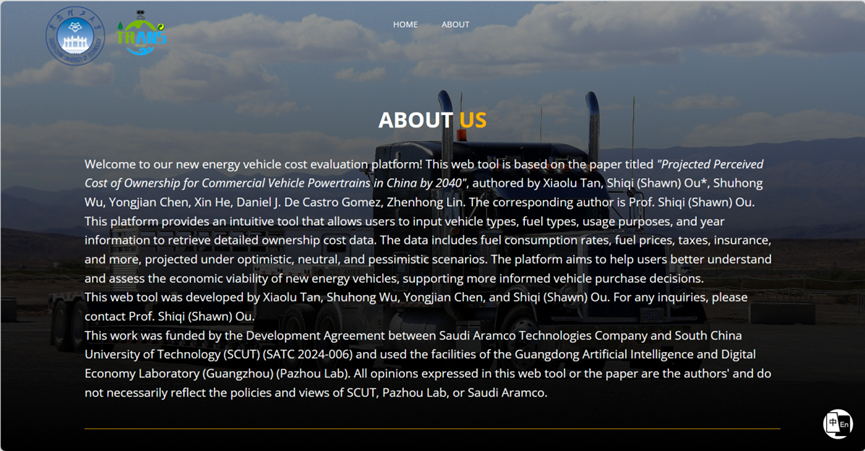
✨ Basic Information and Statement of the TCO Model Website
In the future, the TRANS Research Group will continue to optimize and enhance the current version of the TCO Model. They plan to expand their research scope from commercial vehicles to the passenger car market, introducing more dimensions of data and scenario analysis to provide more personalized solutions for the transportation industry’s green transformation and low-carbon development. Additionally, they aim to promote the deep application and integration of artificial intelligence technology in the transportation energy field.
Thank you for your attention, stay tuned for more team updates! Follow the TRANS Research Group homepage: https://www.translab.top/
Authors: Tan Xiaolu, Wu Shuhong, Chen Yongjian
Initial Review & Editing: Lanxin Shi
Final Review: Shiqi Ou