

On February 5, 2025, Lü Zhilong, a second-year master’s student from the School of Automotive and Traffic Engineering at Hubei University of Arts and Science, delivered an inspiring online academic seminar to the TRANS research group at South China University of Technology via Tencent Meeting. Focusing on two of his groundbreaking papers published in eTransportation, Lü shared cutting-edge advancements in battery safety and health management, sparking vibrant discussions among participants.
Research Presentations
1.《Battery Engineering Safety Technologies (BEST): M5 Framework of Mechanisms, Modes, Metrics, Modeling, and Mitigation》
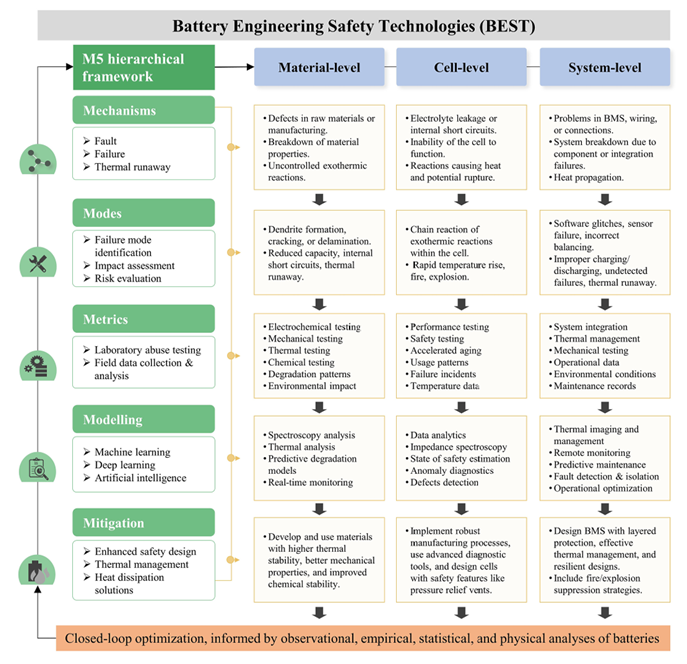
As electric vehicles and lithium-ion batteries play an increasingly vital role in modern energy storage, battery safety has become a critical focus in current energy technology research.
In the first part of his presentation, Lü Zhilong introduced the concept of Battery Engineering Safety Technologies (BEST) and proposed an innovative five-layer framework (M5 framework), encompassing mechanisms, modes, metrics, modeling, and mitigation strategies. This framework integrates multidisciplinary knowledge to systematically analyze major types of battery failures, such as overcharging, over-discharging, short circuits, and overheating. He delved into the potential hazards these failures pose to battery system safety and their severe consequences, including thermal runaway (TR), fires, and explosions. By dissecting failure modes and their specific impacts on performance, Lü emphasized technological advancements in material optimization, battery design, and systemic improvements, particularly in preventing thermal runaway and related risks. He further highlighted that advanced battery management systems can effectively preempt failures, ensuring battery safety and stability. Additionally, Lü outlined the promising future of applying machine learning and artificial intelligence for battery safety diagnostics, demonstrating the immense potential of these fields. Data-driven diagnostic and predictive methods, he noted, could significantly improve fault detection efficiency and accuracy, driving transformative progress in battery safety technologies.
2.《Resource-Efficient Artificial Intelligence for Battery Capacity Estimation Using Convolutional FlashAttention Fusion Networks》

In battery capacity estimation tasks, optimizing resource usage while maintaining high efficiency remains a critical challenge for intelligent battery management systems.
In the second part of his presentation, Lü Zhilong introduced an innovative AI model combining 2D convolutional neural networks (CNN) with the FlashAttention-2 mechanism, designed to achieve resource optimization and performance enhancement during battery capacity estimation.The model efficiently extracts local features and integrates advanced attention mechanisms, significantly reducing memory consumption and accelerating computation speed while maintaining high precision, thereby improving overall processing efficiency. Lü highlighted that the model achieves millisecond-level battery health diagnostics and outperforms traditional Transformer models in computational performance.
By enabling cross-chemical health diagnostics, his research demonstrates the model’s immense potential in battery management systems, particularly in advancing intelligent battery management and sustainable development.
Academic Journey & Insights
Lü candidly shared his transition from intelligent connected vehicles to battery research due to team restructuring. He stressed the importance of systematic literature review (10+ papers weekly), iterative experimentation, and mentorship flexibility in overcoming initial challenges. His journey—from adapting to a new field to publishing two high-impact papers within 18 months—underscored resilience, structured learning, and the power of incremental progress.
Key Takeaways
The seminar not only provided technical insights into battery innovation but also showcased Lü’s problem-solving mindset. His advice on embracing interdisciplinary challenges, leveraging data-driven methods, and maintaining persistence resonated deeply, inspiring attendees to navigate uncertainties in their own research journeys.